





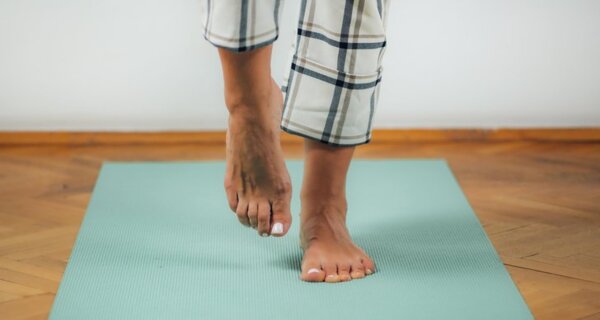
Balancing on one leg may seem simple, but it often becomes more difficult with age. Practicing this skill regularly, however, can build strength, sharpen memory, and support long-term brain health.
Unless you’re a flamingo, standing on one leg probably isn’t something you do often. And depending on how old you are, you may be surprised by how challenging it feels.
When we’re young, balance comes naturally. Most people fully develop this ability by ages 9 or 10. Balance tends to peak in the late 30s and then gradually declines over time.
For adults over 50, the ability to stand on one leg for more than a few seconds can reveal a great deal about overall health and how well the body is aging. More importantly, regularly practicing single-leg balance can offer meaningful benefits—reducing fall risk, improving strength, and even supporting memory and cognitive function. Despite its simplicity, this exercise can have an outsized impact on healthy aging.
“If standing on one leg feels difficult, that’s a sign it’s time to start training your balance,” says Tracy Espiritu McKay, a rehabilitation medicine specialist with the American Academy of Physical Medicine and Rehabilitation.
Why balance matters
One reason healthcare professionals use the one-leg stand as a health marker is its connection to sarcopenia, the age-related loss of muscle mass.
Beginning around age 30, adults lose up to 8% of muscle mass per decade. By the 80s, research suggests as many as half of adults may have clinical sarcopenia. This muscle loss is linked to issues such as poorer blood sugar regulation and weakened immunity, and it directly affects balance and stability.
Because standing on one leg relies on strong leg and hip muscles, declining balance can reflect muscle loss. On the other hand, practicing single-leg exercises may help preserve muscle strength and reduce vulnerability to sarcopenia later in life.
“The ability to stand on one leg decreases with age,” says Kenton Kaufman, director of the motion analysis laboratory at the Mayo Clinic. “People often begin to notice changes in their 50s or 60s, and the decline accelerates with each decade.”
Balance also depends heavily on brain function. Standing on one leg requires coordination between vision, the vestibular system in the inner ear, and the somatosensory system, which helps the body sense position and movement.
“All of these systems age at different rates,” Kaufman explains.
Because of this, single-leg balance can reflect the health of brain regions involved in reaction time, sensory processing, and everyday functioning. Faster brain aging can increase fall risk and reduce independence in later years.
Falls are a serious concern: according to the U.S. Centers for Disease Control and Prevention, unintentional falls are the leading cause of injury among adults over 65. Research shows that balance training can significantly reduce this risk.
“Balance training improves control and actually changes how the brain is structured,” Espiritu McKay says.
Reaction time plays a major role in preventing falls. “When someone trips, avoiding a fall is less about strength and more about how quickly the leg can respond,” Kaufman explains.
Remarkably, one-leg balance is also linked to longevity. A 2022 study found that adults unable to stand on one leg for 10 seconds in midlife were significantly more likely to die from any cause within the next seven years. Other research has shown that the single-leg stance test predicts health outcomes more accurately than grip strength or sit-to-stand tests.
Balance ability has even been linked to cognitive decline. Among people with dementia, those who maintain better balance tend to experience slower cognitive deterioration.
Training your balance
The encouraging news is that balance can be improved at nearly any age. Research shows that single-leg training strengthens muscles while also supporting brain health.
“Our brains are adaptable,” says Espiritu McKay. “Balance exercises can improve sensory-motor integration and spatial awareness.”
Standing on one leg has also been shown to activate the prefrontal cortex and enhance working memory, even in younger adults.
Espiritu McKay recommends that adults over 65 practice single-leg balance exercises at least three times per week, ideally daily. Starting earlier may offer even greater benefits.
Exercise medicine researcher Claudio Gil Araújo suggests adults over 50 test themselves by standing on one leg for 10 seconds. This can be easily worked into daily routines—such as while brushing your teeth—switching legs and practicing both barefoot and with shoes, since footwear changes stability.
Everyday activities like washing dishes or standing at the sink provide natural opportunities to practice balance. Even 10 minutes a day can lead to improvements.
Gentle hip-strengthening exercises and activities like yoga or tai chi, which frequently involve single-leg poses, have also been linked to reduced fall risk and healthier aging. Studies suggest that combining strength, aerobic, and balance training can cut fall-related risks by up to 50%.
Perhaps most inspiring, Araújo notes that balance can be preserved well into very old age. “We’ve assessed people in their 90s who can still hold a single-leg stance for 10 seconds,” he says. “With consistency, the body’s systems can be trained almost until the very end of life.”