


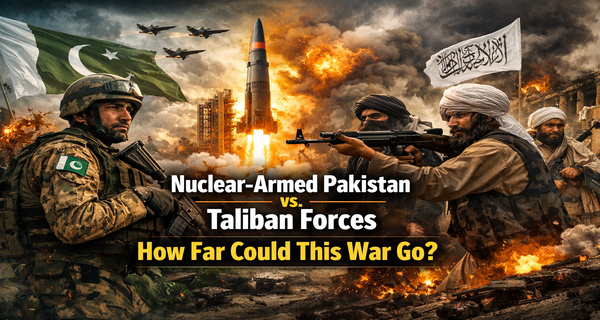
Fighting has erupted once again between Pakistan and Afghanistan, with both sides exchanging heavy shelling and airstrikes along their long, disputed border.
Pakistan’s defense minister declared that the country’s patience had “run out,” describing the situation as an “open war” with Afghanistan’s Taliban-led government.
What Triggered the Latest Violence?
The Afghan Taliban said it launched attacks on Pakistani border positions late Thursday night. According to Kabul, this was retaliation for earlier Pakistani airstrikes inside Afghanistan that allegedly killed at least 18 people.
In response, Pakistan launched a major military operation called “Operation Ghazab Lil Haqq” (Operation Righteous Fury) early Friday.
Pakistani airstrikes reportedly targeted:
- Kabul
- The southeastern province of Paktia
- Kandahar, considered the Taliban’s spiritual stronghold
Pakistan claims it destroyed dozens of Taliban posts and killed hundreds of fighters. Afghanistan disputes those numbers and says Pakistani forces also suffered casualties. Independent verification is difficult due to the remote location of the fighting.
Civilians Caught in Fear
Residents on both sides of the border described terrifying nights filled with explosions, gunfire, and mortar fire. Homes were damaged, and civilians including children were reported injured.
In Kabul, residents said they stayed awake through the night, fearing further bombings.
Why Is This Happening Again?
Although the two countries share deep economic and cultural ties, relations have been strained for years.
After the Taliban returned to power in 2021 following the withdrawal of US and NATO forces, Pakistan has experienced a sharp rise in militant attacks. Islamabad blames the Pakistani Taliban (TTP), accusing Afghanistan of providing them safe haven a claim the Taliban government denies.
More than 1,200 people were reportedly killed in militant attacks inside Pakistan in 2025 alone, according to Pakistani military data.
What’s at Stake?
This latest escalation threatens:
- Regional stability
- Cross border trade
- Diplomatic relations
- Civilian safety
While Afghan officials say they still want dialogue, tensions are rising fast and the risk of a broader regional conflict is growing.
Tensions between Pakistan and Afghanistan continue to intensify and even senior Pakistani officials acknowledge the situation may be a case of long-term “blowback.”
In a previous interview, Pakistan’s Defense Minister Khawaja Asif admitted that the current surge in violence could indeed be the result of past policies. When asked whether this was “blowback,” he responded:
“Yeah, I think so.”
He has also accused Afghanistan of harboring militants and “exporting terrorism,” while restricting human rights internally. On social media, he declared:
“Our patience has run out. Now it is open war between us and you.”
Military Power: A Stark Imbalance
According to the International Institute for Strategic Studies and its report Military Balance 2025, the difference in military strength between the two countries is significant.
🇵🇰 Pakistan’s Military Strength:
- ~660,000 active duty troops
- Nearly 300,000 paramilitary and support personnel
- Army, Navy, Air Force, and Marine forces
- Nuclear weapons capability
- Advanced fighter jets, artillery, missile systems
Pakistan’s military is considered the most powerful institution in the country, historically shaping politics through coups and constitutional influence.
🇦🇫 Afghanistan’s Position:
Afghanistan’s Taliban led forces rely more on:
- Guerrilla warfare experience
- Border familiarity
- Captured US military equipment
- Drones and asymmetric tactics
While Afghanistan cannot match Pakistan in conventional power, analysts warn that asymmetric warfare, urban retaliation, and insurgent style attacks could offset some of that imbalance.
The Bigger Risk
The danger is not necessarily a traditional full-scale war but:
- Urban attacks
- Drone warfare
- Escalating retaliation cycles
- Increased regional instability
With both sides hardening their rhetoric, the key question remains:
👉 Will this remain a border conflict, or escalate into a prolonged regional crisis?
🇵🇰 Pakistan: Conventional Military Power
Pakistan fields a modern and well-equipped force, including:
- US-made F-16 fighter jets
- French Mirage aircraft
- JF-17 Thunder jets co produced with China
- A structured Army, Navy, and Air Force
- Nuclear weapons capability
- ~660,000 active duty troops (plus large paramilitary forces)
Its air power and advanced weapons systems give Islamabad overwhelming superiority in a conventional war scenario.
🇦🇫 Afghanistan: Asymmetric Warfare
In contrast, Afghanistan’s force is essentially the Taliban.
- Estimated under 200,000 fighters
- No functioning modern air force
- Limited aging helicopters left from the Soviet and US eras
- Increasing use of quadcopter drones
- Heavy reliance on guerrilla tactics
While lacking advanced weaponry, the Taliban’s fighters are battle hardened after decades of insurgency including their 2021 victory following the US withdrawal. Their strength lies in asymmetric warfare, ideological cohesion, and unconventional tactics.
How Bad Could It Get?
Historically, flare ups between the two sides have cooled after several days of fighting, sometimes with mediation from countries like Saudi Arabia and Turkey.
But experts fear this time could be different.
Abdul Basit of the S. Rajaratnam School of International Studies warned:
“Any retaliation by the Afghans will be in Pakistan’s urban centers… This is a recipe for chaos.”
He also noted:
“Drones are a poor man’s air force. The Afghan Taliban have drones, they have suicide bombers, they are innovative.”
Meanwhile, Samina Ahmed of the International Crisis Group cautioned that Pakistan has made it clear it will strike again if Kabul does not act against TTP leaders allegedly operating from Afghan soil.
She urged:
Islamabad and Kabul must urgently resume negotiations with mediation from trusted partners such as Turkiye, Qatar, and Saudi Arabia.
The Real Danger
The greatest risk may not be a traditional full scale war but:
- Urban retaliatory attacks
- Drone warfare
- Proxy militant escalation
- Regional destabilization
If diplomacy fails, this conflict could shift from border clashes to a broader security crisis affecting all of South Asia.