





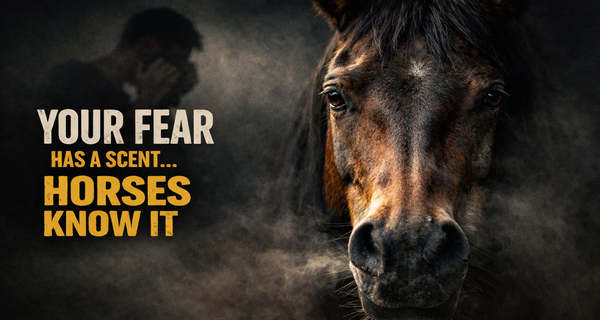
A new scientific study suggests that horses can sense fear in humans through smell — and when they do, they become more alert, cautious, and easier to startle.
Researchers collected sweat samples from the underarms of human volunteers and then observed how horses reacted when exposed to those scent samples. The findings were published Wednesday in the journal PLOS One.
Previous studies had already shown that horses can recognize human emotions through facial expressions and tone of voice. However, whether they could detect emotions through scent had remained largely theoretical because studying smell is technically challenging, explained lead author Plotine Jardat of the French Institute for Horse and Riding (IFCE).
“As humans, we are not very aware of the range of smells around us, unlike many animals,” Jardat told CNN. “That makes this kind of research more complicated.”
To address this, researchers placed cotton pads under the arms of participants to absorb sweat — where emotional odor compounds are released. Samples were collected while participants watched frightening videos, joyful videos, and neutral footage.
These scent pads were later attached near the nostrils of 43 female horses using small mesh nets. To avoid contamination, only the person providing the sample handled their own pad, and the pads were frozen to preserve the chemical compounds.
The horses were then put through standardized behavioral tests conducted by handlers familiar to them. For example, researchers observed whether the horses would willingly approach a person in their paddock or how they reacted to a suddenly opened umbrella.
Scientists monitored not only behavior but also physical stress indicators, including heart rate and cortisol levels in saliva — a hormone linked to stress.
The results showed clear differences. Horses exposed to sweat from people who had watched frightening videos were more reactive. They startled more easily and were less likely to approach humans or explore unfamiliar objects.
“The fearful human odors intensified the horses’ responses,” Jardat explained. “This means horses can detect how we feel through scent, even if they can’t see or hear us.”
Co-author Léa Lansade of the French National Research Institute for Agriculture, Food and Environment (INRAE) described the findings as evidence of emotional contagion between species.
The study has practical implications for riders and handlers. It highlights the importance of a person’s emotional state during interactions with horses, since stress-related chemical signals may influence the animal’s behavior.
While humans cannot consciously control the scent compounds released when experiencing emotions, Lansade advised riders to focus on relaxation to avoid transmitting fear to their horses.
The research team now plans to investigate whether humans can detect emotional scent signals from horses as well. They also want to determine whether this chemical communication is limited to fear or extends to other emotions such as sadness or disgust.
“We began with fear because it’s a universal survival emotion linked to danger detection,” Jardat said. “Even if horses don’t experience emotions exactly like humans do, they may still recognize chemical differences that signal something important.”
Gemma Pearson, a veterinary behavior specialist at the Royal (Dick) School of Veterinary Studies in Scotland who was not involved in the study, praised the research. She noted that the team carefully controlled for variables that could have affected the results.
Pearson emphasized that horses rely on multiple senses simultaneously.
“As prey animals, horses are naturally tuned to detect potential threats in their environment,” she said. “They don’t rely solely on the smell of fear — in real-world situations they combine scent with sight, sound, and other cues to assess risk.”
The study strengthens growing evidence that the human-horse bond involves subtle and complex forms of communication — including signals we may not even realize we are sending.