





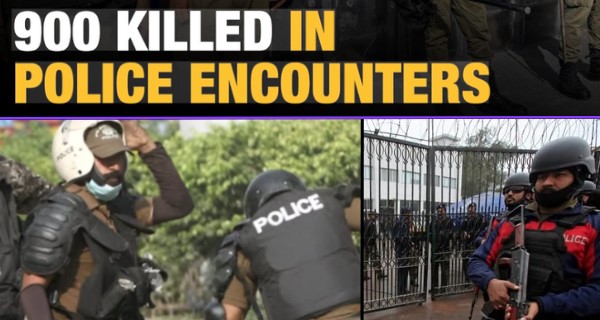
A new human rights investigation alleges that a specialised police unit in Pakistan’s Punjab province has carried out an unprecedented number of extrajudicial killings.
Islamabad, Pakistan – When officers from Pakistan’s Crime Control Department (CCD) stormed Zubaida Bibi’s home in Bahawalpur, southern Punjab, last November, they reportedly seized everything — mobile phones, cash, gold jewellery, and even her daughter’s wedding dowry. Most devastatingly, they took her sons.
Within a day, five members of her family were dead. Authorities said they were killed in separate “police encounters” across different districts of Punjab — Pakistan’s most populous province.
Her sons — Imran (25), Irfan (23), and Adnan (18) — along with two sons-in-law, were among those killed.
“They forced their way into our house and took all that we had,” Zubaida told a fact-finding delegation from the Human Rights Commission of Pakistan (HRCP). “We followed them to Lahore and pleaded for our sons’ release. The next morning, all five were dead.”
After filing a legal petition, she claims police warned her that the remaining family members would be killed if she did not withdraw the case.
Her husband, Abdul Jabbar, maintains that their sons had no criminal background. “They were working men with families and children,” he said.
Their story is central to a February 17 HRCP report, which concludes that Punjab’s CCD is allegedly implementing what it describes as a “systemic policy of extrajudicial killings” that violates both the law and Pakistan’s Constitution.
According to HRCP data, between April 2025 — when the CCD was established — and December 2025, at least 670 police “encounters” resulted in 924 suspected deaths.
The CCD was created to tackle organised and serious crime. However, HRCP portrays it as functioning like a parallel police force operating with near total impunity, contributing to a dramatic spike in encounter killings and sparking national debate over rule of law and the protection of life.
Farah Zia, HRCP’s director, noted that Punjab historically saw the emergence of encounter killings as far back as the 1960s, partly due to a policing culture where torture and impunity were common. Over time, similar practices spread to other provinces, especially Sindh.
She criticised authorities for relying on “short-term, illegal measures” instead of strengthening forensic investigations, community policing, and effective prosecution systems.
A new unit, rising fatalities
Under Punjab Chief Minister Maryam Nawaz Sharif, the CCD was launched as part of the province’s “Safe Punjab” initiative, aimed at dismantling organised gangs and targeting hardened criminals.
Within weeks of its formation, reported police encounters rose sharply. In eight months, more than 900 suspects were killed. During the same period, two police officers lost their lives and 36 were injured.
For comparison, HRCP recorded 341 suspects killed in encounters across Punjab and Sindh combined during all of 2024. The CCD alone more than doubled that number in less than a year.
Lahore recorded the highest number of encounters (139), followed by Faisalabad (55) and Sheikhupura (47).
Many of those killed were accused of armed robbery or gang-related crimes (366 deaths), while others faced allegations related to narcotics (114), robbery (138), or murder (99).
Repeated patterns
The HRCP report highlights striking similarities in official police accounts. Typically, suspects are described as riding motorcycles at night, behaving suspiciously. Police claim the suspects open fire first, forcing officers to shoot in self-defence. Surviving accomplices allegedly escape under cover of darkness.
The commission noted nearly identical language across numerous police reports, including accounts where fatally wounded suspects supposedly regain consciousness long enough to provide full identification details before dying.
Such repeated phrasing suggests “copy-paste reporting” rather than case-specific documentation, according to HRCP.
Official police press statements, often circulated to journalists via WhatsApp, tend to emphasise the alleged criminal history of the deceased while providing few procedural details.
Human rights lawyer Asad Jamal said political leadership appears to support aggressive tactics, arguing that authorities may believe lowering crime statistics justifies bypassing due process.
Government response
In court submissions cited by HRCP, the CCD claims its operations have reduced property crimes by over 60 percent compared to the previous year and significantly lowered dacoity-related murders.
Police maintain they operate under an intelligence-led model and reject accusations of extrajudicial killings, stating that HRCP lacks sufficient evidence.
HRCP counters that even if crime rates decline, the method used is critical. Whether crime is addressed through investigation and judicial process or through summary execution determines the character of the state, the commission argues.
Families told investigators they were pressured to bury victims quickly, before independent postmortems could be conducted.
The commission also reported that requests for official data and meetings with senior police and provincial authorities went unanswered.
A broader pattern
Over the past decade, nearly 5,000 police encounters have been recorded nationwide, with almost 2,000 in Punjab alone. While annual figures between 2020 and 2023 remained below 400 in Punjab, 2024 saw a sharp increase to over 1,000 cases.
Human rights observers have long alleged that many encounters are staged — effectively executions without trial.
Lawyer Rida Hosain described such practices as remnants of colonial and authoritarian systems that treated citizens as subjects rather than individuals entitled to legal protection.
She warned that normalising state-sanctioned violence risks expanding its targets beyond alleged criminals.
“Guilt must be determined through courts, not through bullets,” she said. “If these actions go unchallenged, tomorrow’s victims may not be criminals at all.”